Wednesday, 21 December 2011

Reminder from the Quran - Selected Verses. Test of Abraham.


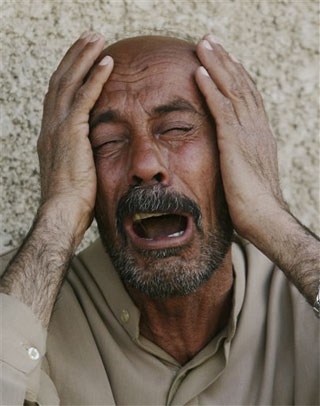
Note : The picture above does not represent Abraham or Isaac (peace be upon them). 


Quran - Surah Saffat ( Ranged in Ranks ) verses 101 to 110 ) -


[37:101] (Abraham prayed) ‘My Lord, grant me a righteous son.’
[37:101]

[37:102] So We gave him (Abraham) the glad tidings of a forbearing son.
[37:102]

[37:103] And when he was old enough to work with him, he said, ‘O my dear son, I have seen in a dream that I am slaughtering thee. So consider, what thou thinkest of it!’ He replied, ‘O my father, do as thou art commanded; thou wilt find me, if Allah please, of those who are patient.’
[37:103] 

[37:104] And when they both submitted to the Will of God, and he had thrown him down on his forehead,
[37:104]

[37:105] We called to him: ‘O Abraham,
[37:105]

[37:106] ‘Thou hast indeed fulfilled the dream.’ Thus indeed do We reward those who do good.
[37:106]

[37:107] That surely was a manifest trial.
[37:107]

[37:108] And We ransomed him with a great sacrifice.
[37:108]

[37:109] And We left for him a good name among the following generations —
[37:109] 

[37:110] ‘Peace be upon Abraham!’
[37:110] 

Reminder from the Quran - Selected Verses. You will be tested.


Alif-Lam-Mim. 

Do people think that they will be left alone because they say: ‘We believe’, and will not be tested. 


And We indeed tested those who were before them. And Allah will certainly make known those who are true, and and will certainly make known those who are liars.


- Quran- Chapter Al-Ankabut ( 29) :1-3

Sunday, 18 December 2011

How to read the Quran ?

Peace be with you.


How to read the Quran ? It is such an innocent and simple question. Nevertheless, the answer(s) might be simple or otherwise. It depends on what you are looking for.

The Quran in the original is written in Arabic. The man , Muhammad (peace be upon him), was an Arabian Prophet sent to all mankind. As such, if you happens to pick the Quran up either in a translation or the original, the message in the Quran is indeed addressed to you.

If you are a Muslim than reading the Quran in Arabic is part of a Muslim tradition in so called Sunday classes. As a kid you might remember your Quran teacher taking the trouble to teach you to pronounce those foreign Arabic words if you are non-Arab. Sometimes you get beaten up for misbehaving in class or your tongue was just not meant to pronounce Arabic words. Somehow after sometime, you will get use to it.

For a non Muslim, either out of pure curiosity, fault finding or you are planning to marry a Muslim man or woman, than reading the Quran in a translation be it in any language would be an invaluable  experience. Either you are a Muslim or non Muslim, there are no advantages or disadvantages because the God of the Quran is the same be it to Muslim or non-Muslim.

Again, how do we read the Quran ?

The most important thing about reading the Quran is to establish your intention of reading this book ? Why do you want to read the Quran ? That answer part of the question of how to read the Quran ?

The greater the need to understand the Quran, the more the book will open-up itself to you. The Quran is like a unified resource location (URL) where the whole book is connected to God (Himself). As long as you are connected to God, once you are wired up to the Quran , than you will be able to grasp the meaning of the message. The whole Quran originates from a Preserved Tablet . That tablet is in God's knowledge.  

Once you established your intention of reading the Quran, than there are some simple protocols that you need to observe. 

That this is indeed a Quran most honourable. In a Book well guarded. Which none shall touch but those who are clean:
Quran - Chapter 56 (Al-Waqiah) verse 79

It doesn't matter whether you are a Muslim or non Muslim, but we all agreed that physical cleanliness is just common-sense.  Since you know that the Quran is the Word of God, even if you don't believe in Islam, you should be in a clean state before reading the Quran. It is not proper to read the Quran in an unclean state or environment. What about menstruating women ? Can they read the Quran ? The answer is yes. There is no reason why menstruating women can't read the Quran. Just be sure that you have everything in control and nothing spills out. You should be ok. If you are a believer and you have just had intercourse with your spouse, make sure that you take a bath so that you are not in ceremonial impurity before reading the Quran. This is again common-sense. For non-Muslim, shower after sex is common sense as well.  

The above are not of primary importance. The primary concern  is the spiritual part of it. Your intention must be clean when you approach the Quran. That is the context of the verse above. You must rid your mind of any unclean thoughts, evil intentions, prejudices, pre-conceive notions or any other disturbing condition like in a rage or anger before reading the Quran. 

As a reader of a translation of the Quran, do not feel that you are loosing any essence of the message. The Quran will open itself up to you if you are sincere. Reading a translation will be a good start. The whole idea behind this is to start reading the Quran and make it a daily affairs. To read the Quran is like going for a long journey. You must keep on walking in order to reach your destination. No doubt you will find obstacles and difficulties in your path, but you need to move on in order to reach your destiny. Once you read the Quran, you are connected to God, you will get connected to the message of the Quran and that part of the message in the Quran will be in turn connected to your life. Your relationship with God will develop, your understanding of the Quran will develop gradually and you will understand your life better.

Before you start reading the Quran, it doesn't matter whether you are Muslim, Hindu, Christian, Jew or even non believer, it will be good to seek protection in God from Satan the Accursed. 

When you do read the Quran, seek God's protection from Satan, the Rejected One.
Quran - Chapter 16 (An-Nahl) verse 98. 

You may begin your reading of the Quran, either from 1st Chapter or you may also begin from the last chapter. You are allowed to begin anywhere you like. From the middle, 1/3rd of the book, 2/3rd of the book or any other way you wish to start from. Thats the beauty of the Quran. Read  few verses daily and have a book marker. So that you know where you stop and from where you should begin. In the beginning, you might not be able to understand everything that you read. Don't worry. Continue reading. 

Follow this link to start reading the Quran. This is an English Translation of the Arabic Quran by Abdullah Yusuf Ali.


The Yusuf Ali English text is based on the 1934 book, The Holy Qur-an, Text, Translation and Commentary, (published in Lahore, Cairo and Riyadh). This version is widely used because it is a clear, modern and eloquent translation by a well-respected Muslim scholar. The English text was revised in 2009-10 to more closely match the source book. 

Another method of reading is just by looking at the Index. Many translations of the Quran, in English especially, at the back end of the translation, you will find a very comprehensive index. Subjects found within the Quran, listed alphabetically. You may browse at your leisure and read subject by subject what the Quran say about almost anything. Kindly refer to the link below to find the Quranic Index.


Start your journey now. Read the Quran and change your life before it changes you.

"That Day (resurrection), will every soul be requited for what it earned; no injustice will there be that Day, for God is swift in taking account.
Quran - Chapter 40-(Ghafir) verse 17   

Next posting - How to read the Quran ? Part 2 - An introduction to English translators and translations. Insya Allah.


                                            Good advise on how to read the Quran.

Friday, 16 December 2011

Fatihah - The Opening (First Chapter of the Quran)


Translation

In the Name of God, The Gracious, The Merciful
Praise be to God, Lord of the Universe
The Gracious, The Merciful
King of the Day of Judgement
You alone we worship, You alone we ask for help
Guide us to the straight path
The path of those whom You blessed
not of those who deserved Your wrath
nor of the strayers.

Quran - A Message To All Mankind

The Quran, is God's last and final message to mankind. It contains among others, guidance for proper living, healing and mercy to believers, moral code of ethics, instructions on how to be righteous, explanations about the truth of this life, elucidates about the purpose of life and a message to all mankind. This book was revealed to an Arab, Muhammad (peace be upon him) more than one thousand four hundred years ago in the desert of Arabia. 

It must be stressed that the Qur’an is accurate about many, many things, but accuracy does not necessarily mean that a book is a divine revelation. In fact, accuracy is only one of the criteria for divine revelations. For instance, the telephone book is accurate, but that does not mean that it is divinely revealed. The real problem lies in that one must establish some proof of the source the Qur’an’s information. The emphasis is in the other direction, in that the burden of proof is on the reader. One cannot simply deny the Qur’an’s authenticity without sufficient proof. If, indeed, one finds a mistake, then one has the right to disqualify it. This is exactly what the Qur’an encourages.

The basic question one must ask oneself is "Could this Qur'an be the words of any other than God." In reaching your conclusions there are a number of factors to bring into your judgement. Firstly we must consider how this object came into existence and how reliable is the description offered of how it came into existence. 

Then we need to begin our investigation of the object in question. Through doing this we begin to notice certain characteristics about the text and start to study it in detail, noticing certain subtleties. The establishment of general consistency with our knowledge is of primary importance since if we find things in it which contradict what we know, it will immediately be making demands on our credulity rather than challenging our conscience to accept it as true, so that we would feel guilty not accepting it. 

Further investigation shows consistency with current knowledge that is quite amazing. Coincidence also plays an interesting role in discovering curiosities about the Qur'an which show some amazing aspects of the structure. In the process we continually consider whether there is any credible alternative explanation of the origins of the Qur'an and ask ourselves, is it too hard for us to accept any other explanation with a clear conscience that our thinking remains good? What are our doubts about the explanation that this amazing Qur'an comes from other than God? Are these doubts reasonable?

Another example of peoples use of this weak stance can be found in the Makkans explanation of the source of Muhammads message. They used to say, The devils bring Muhammad that Quran! But just as with every suggestion made, the Quran gives the answer. One verse (Surah Al-Qalam 68: 51-52) in particular states:
And they say, Surely he is possessed [by jinn],but it [i.e., the Quran] is not except a reminder to the worlds.
Thus it gives an argument in reply to such a theory. In fact, there are many arguments in the Quran in reply to the suggestion that devils brought Muhammad (r) his message. For example, in the 26th chapter Allah (I) clearly affirms:
No evil ones have brought it [i.e., this revelation] down. It would neither be fitting for them, nor would they be able. Indeed they have been removed far from hearing. (Surah ash-Shu’ara 26:210-212)
And in another place (Surah an-Nahl 16:98) in the Quran, Allah (I) instructs us:
So when you recite the Quran seek refuge in Allah from Shaytan, the rejected.
 Now is this how Satan writes a book? He tells one, Before you read my book, ask God to save you from me? This is very, very tricky. Indeed, a man could write something like this, but would Satan do this? Many people clearly illustrate that they cannot come to one conclusion on this subject. On one hand, they claim that Satan would not do such a thing and that even if he could, God would not allow him to; yet, on the other hand, they also believe that Satan is only that much less than God. In essence they allege that the Devil can probably do whatever God can do. And as a result, when they look at the Quran, even as surprised as they are as to how amazing it is, they still insist, The Devil did this!
Praise be to Allah (I), Muslims do not have that attitude. Although Satan may have some abilities, they are a long way separated from the abilities of Allah. And no Muslim is a Muslim unless he believes that. It is common knowledge even among non-Muslims that the Devil can easily make mistakes, and it would be expected that he would contradict himself if and when he wrote a book. For indeed, the Quran states (Surah an-Nisa 4:82):
Do they not consider the Quran? Had it been from other than Allah, they would surely have found therein much discrepancy.
Certainly, one could continue on and on with this example, drawing up longer and longer list of good guesses; and of course, the odds would become higher and higher with each increase of subjects about which one could guess. But what no one can deny is the following: the odds that Muhammad (r), an illiterate, guessed correctly about thousands and thousands of subjects, never once making a mistake, are so high that any theory of his authorship of the Quran must be completely dismissed - even by the most hostile enemies of Islam!
Indeed, the Quran expects this kind of challenge. Undoubtedly, if one said to someone upon entering a foreign land, I know your father. I have met him, probably the man from that land would doubt the newcomers word, saying, You have just come here. How could you know my father? As a result, he would question him, Tell me, is my father tall, short, dark, fair? What is he like? Of course, if the visitor continued answering all of the questions correctly, the skeptic would have no choice but to say, “I guess you do know my father. I dont know how you know him, but I guess you do!”
The situation is the same with the Quran. It states that it originates from the One who created everything. So everyone has the right to say, Convince me! If the author of this book really originated life and everything in the heavens and on the earth, then He should know about this, about that, and so on. And inevitably, after researching the Quran, everyone will discover the same truths. Additionally, we all know something for sure: we do not all have to be experts to verify what the Quran affirms. Ones Iman (faith) grows as one continues to check and confirm the truths contained in the Quran. And one is supposed to do so all of his life.

May God (Allah) guide 
everyone close to the truth.